On 3/16/2014 12:12 PM, Tim C wrote:
> We are scheduling a workshop for this upcoming Tuesday, March 18th. There may be a couple of things happening this Tuesday. We will have a tester available to see progress of existing mirrors. I think we are going to take a look at a 10" mirror to see its shape right now. This will dictate which direction to take looking forward. As we have somewhat of a knowledge of this mirror, I believe it may be suggested to first take it back to a sphere, then work on figuring the mirror to a paraboloid shape. For now we will get a great idea of the shape. Stroke shapes, duration of strokes to use to get back to a sphere will be suggested.With vast knowledge available to you from our experts, suggestions may be made to guide the figuring to a parabola right from this state of the wavefront! It's really tricky to do this though. If you are not familiar with figuring, it may be best to go directly back to a sphere. Then, after becoming more familiar with the feel of the pitch over the mirror, you will feel more at home and figuring a little more understandable. For those of you that wish to know more about figuring, you may not want to miss this. Unfortunately, I will most likely not make the class this week due to a busy workload. If I can get there though, I will be grinding on our donated 8" one last hour before I go to polishing. It seems like our little workshop is doing magnificently well. Please feel free to join in if you want!
> T
Monday, March 17, 2014


Thursday, March 13, 2014
140312 re: Porter Garden telescope
On 3/13/2014 8:33 AM, Joe D wrote:
Hi All,
FYI I did contact the people making the Porter and every time I spoke with them it got more expensive. Really expensive. In the last conversation they wanted around $7000 for part of a focuser.
Eventually I made a maple base, which I do think came out pretty nice and in reasonable harmony with the original art deco bronze. (FYI we did not have an original base to make a casting from.) I also had to make a focuser assembly, with 20+ pieces this worked well but did not look art deco. We had a chance to cake a copy of an original focuser (some other museum or club had an original and allowed us to borrow a mold) but at that point we had been on the project over 2 years and we all wanted to wrap it up and the person who was going to spearhead the casting part of the project bailed.
FYI we did use it one night, it had a great image (considering that it has a Tim C mirror, there is no surprise here) but was quite awkward to aim and use. It is way to heavy & bulky to move around often. Really it was not a great scope under the start but as Indiana Jones would say, "It belongs in a museum!"
The Porter Scope restoration was an interesting project for me but I consider it DONE, especially considering that the museum is no longer displaying it to the public. Still if anyone wants to pursue this, I will be happy to turn over all my notes.
Cheers,
Joe
On Mar 12, 2014, at 9:19 PM, Tim C wrote:
This is good news. Interesting. I know the cost of the replica Porter Scope was somewhere in the vicinity of 40,000. Joe D contacted these people once( I think it was Joe). He had a difficult time dealing with them to get"part" of the scope redone. It turned out I think to be much more than what was quoted to you for the base part, in fact, I'm sure of it. I hope we can discuss this further , especially with the powers that be. In the meantime Christopher, great work. You are an extremely interesting artist with seemingly a wealth of resources at your disposal. Please thank Nevin for his in depth reply to you. I do believe the Museum may be very interested in this development. In fact, I am CCing Javier R, who I hope you have had the pleasure of meeting already ( I think you have). We'll see how this all shakes out. I am just not sure how much interest this will have at this particular time from the Museum's position. They have a lot of irons in the fire. We may want to let the club officers know through Tom T of this. Again, thank you for this news regarding this wonderful piece in the Museum's possession.
T
On Mar 12, 2014, at 2:00 PM, christopher u wrote:
Hi Guys,
I wrote Nevin Littlehale to inquire about the cost for replacing the bronze base of the Porter Garden Scope. We had spoken about it a while back and I had forgotten to ask earlier. It seems much less expensive a prospect than I had though (approximately $700us see below). It really would be a beautiful addition to the museum.
I'm not sure how and to whom the information could be forwarded.
Best,
C.U.
From: Christopher U
 Date: Mon, Mar 10, 2014 at 12:21 PM
Subject: Garden telescope base restoration estimate?
To: Nevin Littlehale
Hello Nevin,
It's Chris U from painting at SBCC. I was speaking with some people from an astronomy club Santa Barbara Astronomical Unit. They told me that the SBMNH has an incomplete 1920's Porter Garden Telescope. They just need to remake the base which is missing completely. It is a beautiful and important object so...
-They were wondering if possible and approximately how costly it would be to replicate the base. What do you think?
RESPONSE FROM NEVIN:
To make something like that I will have to make a model and then pull a mold off of it then cast it in Bronze. I could also design it in Autodesk inventor and print it then cast it. How soon do they need this? Can I come and look at the original and get some spec's on it? All told it shouldn't be more than $700.00.
http://www.novacon.com.br/odditycameras/portergradene.htm
Hi All,
FYI I did contact the people making the Porter and every time I spoke with them it got more expensive. Really expensive. In the last conversation they wanted around $7000 for part of a focuser.
Eventually I made a maple base, which I do think came out pretty nice and in reasonable harmony with the original art deco bronze. (FYI we did not have an original base to make a casting from.) I also had to make a focuser assembly, with 20+ pieces this worked well but did not look art deco. We had a chance to cake a copy of an original focuser (some other museum or club had an original and allowed us to borrow a mold) but at that point we had been on the project over 2 years and we all wanted to wrap it up and the person who was going to spearhead the casting part of the project bailed.
FYI we did use it one night, it had a great image (considering that it has a Tim C mirror, there is no surprise here) but was quite awkward to aim and use. It is way to heavy & bulky to move around often. Really it was not a great scope under the start but as Indiana Jones would say, "It belongs in a museum!"
The Porter Scope restoration was an interesting project for me but I consider it DONE, especially considering that the museum is no longer displaying it to the public. Still if anyone wants to pursue this, I will be happy to turn over all my notes.
Cheers,
Joe
On Mar 12, 2014, at 9:19 PM, Tim C wrote:
This is good news. Interesting. I know the cost of the replica Porter Scope was somewhere in the vicinity of 40,000. Joe D contacted these people once( I think it was Joe). He had a difficult time dealing with them to get"part" of the scope redone. It turned out I think to be much more than what was quoted to you for the base part, in fact, I'm sure of it. I hope we can discuss this further , especially with the powers that be. In the meantime Christopher, great work. You are an extremely interesting artist with seemingly a wealth of resources at your disposal. Please thank Nevin for his in depth reply to you. I do believe the Museum may be very interested in this development. In fact, I am CCing Javier R, who I hope you have had the pleasure of meeting already ( I think you have). We'll see how this all shakes out. I am just not sure how much interest this will have at this particular time from the Museum's position. They have a lot of irons in the fire. We may want to let the club officers know through Tom T of this. Again, thank you for this news regarding this wonderful piece in the Museum's possession.
T
On Mar 12, 2014, at 2:00 PM, christopher u wrote:
Hi Guys,
I wrote Nevin Littlehale to inquire about the cost for replacing the bronze base of the Porter Garden Scope. We had spoken about it a while back and I had forgotten to ask earlier. It seems much less expensive a prospect than I had though (approximately $700us see below). It really would be a beautiful addition to the museum.
I'm not sure how and to whom the information could be forwarded.
Best,
C.U.
From: Christopher U
Subject: Garden telescope base restoration estimate?
To: Nevin Littlehale
Hello Nevin,
It's Chris U from painting at SBCC. I was speaking with some people from an astronomy club Santa Barbara Astronomical Unit. They told me that the SBMNH has an incomplete 1920's Porter Garden Telescope. They just need to remake the base which is missing completely. It is a beautiful and important object so...
-They were wondering if possible and approximately how costly it would be to replicate the base. What do you think?
RESPONSE FROM NEVIN:
To make something like that I will have to make a model and then pull a mold off of it then cast it in Bronze. I could also design it in Autodesk inventor and print it then cast it. How soon do they need this? Can I come and look at the original and get some spec's on it? All told it shouldn't be more than $700.00.
http://www.novacon.com.br/odditycameras/portergradene.htm
Tuesday, March 11, 2014
140309 TimC mirror area Cosmos
On 3/9/2014 10:34 PM, Tim C wrote:
We are scheduling a workshop for this week, March 11th. Bill, please could you have the side gate open. Thank you much. I will not be attending this week, but Jerry Wilson will do the honors. Attend if you wish. There is a chance the outreach scheduled for this week may be cancelled and if that is the case we'll all be back on track.
It was wonderful to see Christopher and his dad Frank at this month's star party. The "flaming tomato" is sprouting wings! If you have an 8" scope and you get a 10" scope, how much more " light grab" will you achieve with the 10 "? Let's ball park this- pi r^2 = area. There for r^2= 4^2= 16. That is the shorthand area of the 8" scope. The 10" is 5^2=25. That is the shortcut area of the 10" mirror. So, if I have it right it's like 64% s'more light grab with the 10" mirror vs. the 8". This becomes important as you progress through the art of mirror making. Everyone hears of aperture fever. In reality though, it is reasonable to think of the relationship of light grab vs. what you are willing to drag to a location to view the stars. In the end, it is perfectly true that the scope that is right is the one you will use the most. I will argue these are the reflectors between 6" and 14". Above those diameters one must use imaginative and intuitive ways to use the larger scopes.

But.... I digress.... It's just so much fun!! I just got finished watching "Cosmos" on one of about 5 different networks. Regardless if a mere President of the United States introduced it, I was really moved by the end of the episode when our friend Neil DeGrasse Tyson showed a book with Sagan's signature and invitation. Very Powerful!!!!! Tyson is a great emissary. I'm sure you wish him well, as I do!
T
Friday, March 7, 2014
From the Workshop...#3 by Tim C
From the Workshop...#3 (from SBAU newsletter, March 2014)
Tim Crawford
From the first two issues of “From the Workshop” we now know what it takes to begin grinding a mirror blank against its tool: the center of the mirror deepens and the edges of the tool wear as they become a perfect complement to the mirror. Now you may ask yourself "How deep do I make the center of my mirror?" In other words, “When should I stop grinding?” This, of course is up to you! What focal length do you want mirror to have? The focal length, F, is the distance from the mirror where parallel (distant) light comes into focus. Moreover, the depth of your mirror at its center determines F. It will also drive some of the design characteristics of your finished telescope, as we will see in future issues. In short, when you reach the desired depth at the mirror’s center, it is time to stop deepening your mirror! What follows are some straightforward “mirror mathematics.”
(1) The Focal Ratio. This number is nothing more than the ratio your mirror’s focal length, F, to your mirror’s diameter. For example, if you are working on an 8” (200mm) diameter blank and you want a focal length of 1000mm, the focal ratio is 1000/200 = 5. You would say that the focal ratio of your desired mirror is 5. Or, equivalently, you are crafting an F/5 mirror.
This ratio has a number of important consequences. One is that a smaller-focal-ratio mirror will have a shorter focal length and, as a result, a deeper center. It may not be obvious at this point, but this type of mirror will have a wider field-of-view. When used with shorter focal length eyepieces, a short focal length mirror will capture larger areas of the night sky. And it will do so with low power. Often this kind of mirror is used in what’s called a “richest field” telescope. Open star clusters are wonderful targets for this kind of telescope!
On the other hand, if you plan to do a lot of planetary viewing, a longer focal ratio mirror will suit you better. Here, with a comparable eyepiece, the longer focal length will supply the higher power needed in seeing details in, say, Jupiter or the Moon.
Keep in mind that there is no focal ratio that “does it all.” A comfortable focal ratio of F/4 to F/6 with focal lengths between 750mm to 1500mm both (a) keep you off tall ladders and (b) allow you to enjoy both ends of the “Planet-to-Cluster” viewing spectrum. I crafted and use a 10" f/5.2 scope and find it easy to use and carry about. It yields fine views of planets and deep sky objects that are within its grasp. So...you pick a number! How about an 8" mirror with an f/6 focal ratio?
In my next essay, I will discuss the mirror’s “radius of curvature" and some other terms that define how our finished mirror will behave optically. Till then, I wish you "clear skies," but only after we get some much needed rain!
Tim Crawford
From the first two issues of “From the Workshop” we now know what it takes to begin grinding a mirror blank against its tool: the center of the mirror deepens and the edges of the tool wear as they become a perfect complement to the mirror. Now you may ask yourself "How deep do I make the center of my mirror?" In other words, “When should I stop grinding?” This, of course is up to you! What focal length do you want mirror to have? The focal length, F, is the distance from the mirror where parallel (distant) light comes into focus. Moreover, the depth of your mirror at its center determines F. It will also drive some of the design characteristics of your finished telescope, as we will see in future issues. In short, when you reach the desired depth at the mirror’s center, it is time to stop deepening your mirror! What follows are some straightforward “mirror mathematics.”
(1) The Focal Ratio. This number is nothing more than the ratio your mirror’s focal length, F, to your mirror’s diameter. For example, if you are working on an 8” (200mm) diameter blank and you want a focal length of 1000mm, the focal ratio is 1000/200 = 5. You would say that the focal ratio of your desired mirror is 5. Or, equivalently, you are crafting an F/5 mirror.
This ratio has a number of important consequences. One is that a smaller-focal-ratio mirror will have a shorter focal length and, as a result, a deeper center. It may not be obvious at this point, but this type of mirror will have a wider field-of-view. When used with shorter focal length eyepieces, a short focal length mirror will capture larger areas of the night sky. And it will do so with low power. Often this kind of mirror is used in what’s called a “richest field” telescope. Open star clusters are wonderful targets for this kind of telescope!
On the other hand, if you plan to do a lot of planetary viewing, a longer focal ratio mirror will suit you better. Here, with a comparable eyepiece, the longer focal length will supply the higher power needed in seeing details in, say, Jupiter or the Moon.
Keep in mind that there is no focal ratio that “does it all.” A comfortable focal ratio of F/4 to F/6 with focal lengths between 750mm to 1500mm both (a) keep you off tall ladders and (b) allow you to enjoy both ends of the “Planet-to-Cluster” viewing spectrum. I crafted and use a 10" f/5.2 scope and find it easy to use and carry about. It yields fine views of planets and deep sky objects that are within its grasp. So...you pick a number! How about an 8" mirror with an f/6 focal ratio?
In my next essay, I will discuss the mirror’s “radius of curvature" and some other terms that define how our finished mirror will behave optically. Till then, I wish you "clear skies," but only after we get some much needed rain!
Thursday, March 6, 2014
140304
140304 Telescope Workshop notes 730-9p Tuesday evening
Attendees: TomT, JerryW, TimC, DmitriiZ, ChrisU

JerryW brought in motorized JMI focuser, w/o motor controller, to donate to 8” donated mirror telescope TimC is working on. TimC checking curve to see if it would fit 8” tube. Tim doing 5 micron polishing this evening.
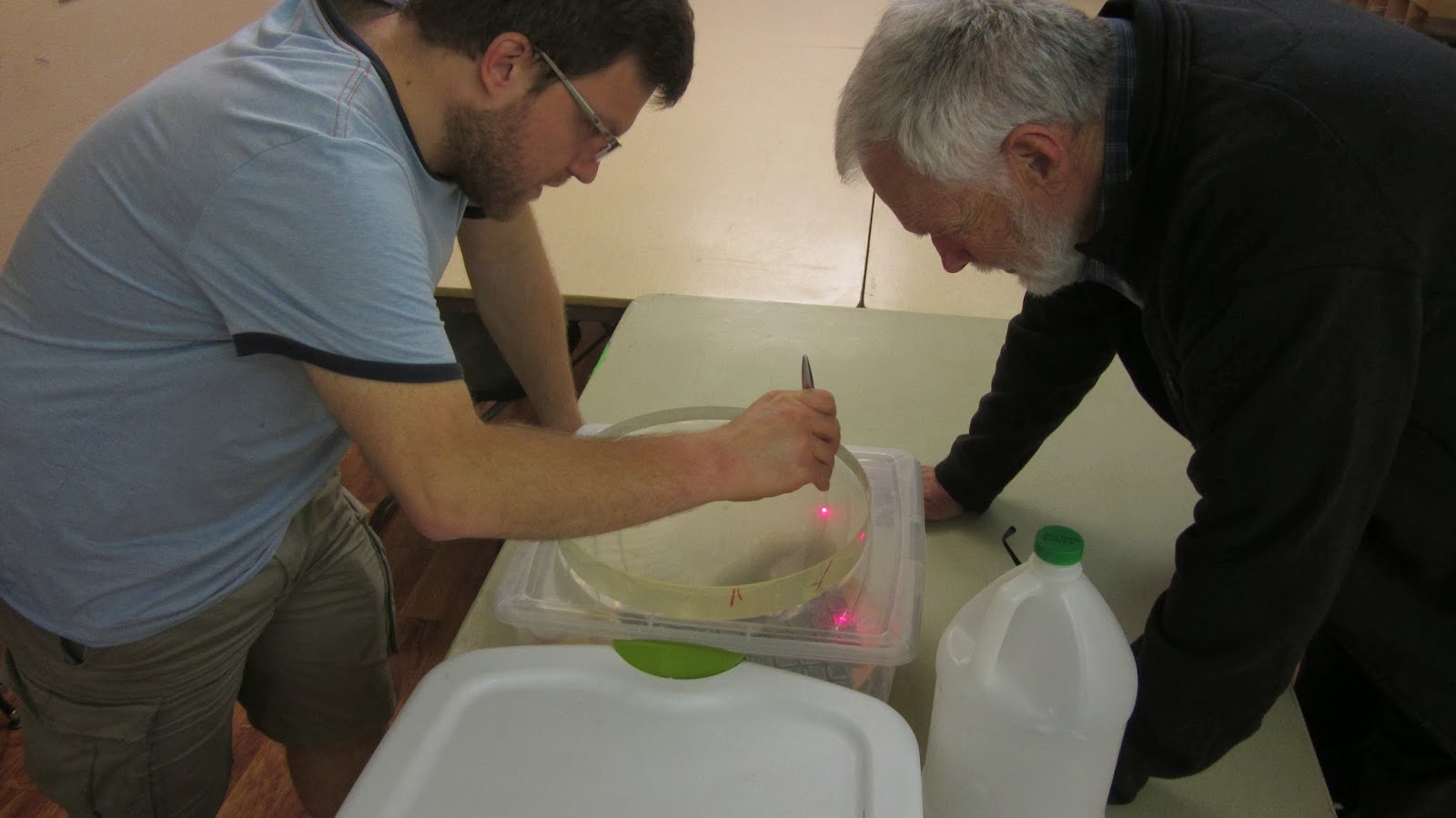 Dmitrii brought in 12.5” mirror for evaluation. He thinks 12 hours of
12.5 micron polishing has been put in since the improper polish was
used. A little scratch in the surface, but laser checking is otherwise
fairly consistent across the mirror. Green higher power laser seems to
give a sharp reflection off the surface. Jerry looking at Jean Texereau
polishing chart with a curve of number of pits left as hours are put
into polishing.
Dmitrii brought in 12.5” mirror for evaluation. He thinks 12 hours of
12.5 micron polishing has been put in since the improper polish was
used. A little scratch in the surface, but laser checking is otherwise
fairly consistent across the mirror. Green higher power laser seems to
give a sharp reflection off the surface. Jerry looking at Jean Texereau
polishing chart with a curve of number of pits left as hours are put
into polishing.

Some time was spent on inviting folks to an Apple icloud area to post photos, then looking at a 3D optical illusion of Saturn stored there.
ChrisU having trouble getting in touch with Newport Glass for cerium oxide. Jerry says China drove people out of business making the stuff, so now hard to get. CR Lawrence, National Abrasives, and Willman Bell may be other sources.
Attendees: TomT, JerryW, TimC, DmitriiZ, ChrisU
JerryW brought in motorized JMI focuser, w/o motor controller, to donate to 8” donated mirror telescope TimC is working on. TimC checking curve to see if it would fit 8” tube. Tim doing 5 micron polishing this evening.
Some time was spent on inviting folks to an Apple icloud area to post photos, then looking at a 3D optical illusion of Saturn stored there.
ChrisU having trouble getting in touch with Newport Glass for cerium oxide. Jerry says China drove people out of business making the stuff, so now hard to get. CR Lawrence, National Abrasives, and Willman Bell may be other sources.
Tuesday, March 4, 2014
140302 TimC notice
On 3/2/2014 9:54 PM, Tim C wrote:
We are scheduling our workshop this week, February 4th, to continue our projects and further our endeavors in this fine craft of optics and scope building. There may be a few items to go over regarding some upcoming events. This I am going to leave open for discussion. We have an upcoming Astronomy Day, May 10th and possible "member's night" presentations we may offer up. I believe these are during the summer months of July and August. I know some have already signed up to do presentations. Maybe some of you have ideas ? I believe the time you will have to share your offering will be in the order of 15 minutes or so?
(Bill,... we really appreciate you having the Broder Building ready for us every week. I hope we leave it better than we find it. That is our wish.)

I am thinking of not having a workshop the following week, February 11th. Some of us have already expressed this will be fine. I have scheduled an outreach for myself and will not be present. If any of you wish to still participate, let me know. It may be best though to just break for one week. The core members of the group I believe are okay with this. [Telescope Tuesday at the Camino Real Marketplace needs help as Chuck/Pat are doing another event.]

This break does effect my plan to be polishing our donated mirror. It will set me back one week, but, I may do a little work at home. This will keep the project on time. I will be giving a time table for building our little 8" scope in the very near future. In the meantime, I know there are at least two other mirrors that will be in the polishing phase. In fact, get this- we will be polishing and figuring out 3 different mirrors at the same time very soon. No- make that 4! Two 12.5" mirrors, one 10" mirror and one 8" mirror. Come on Tom K. Make it 5!

You know, there are some of you on the email list that have expressed interest in grinding a mirror. I can tell you, it is a worthwhile venture. It is really cool to look up and see a target in the night sky. But seeing it with something you personally handcrafted yourself- well it is dreamlike. You will step into the shoes of those who worked out the processes, painstakingly made contraptions to test them and lifted us all to see more than just the stars. People like John Dobson or Jean Texerau. Both have recently left us. They have lifted us to the eyepiece. It is for us to "look through".
See you Tuesday....I want to say also, I am honored to be amongst you.
T
Thursday, February 20, 2014
140218
140218 Telescope Workshop notes 730-9p Tuesday evening
Attendees: DmitriiZ, TomT, JerryW, TimC, EdK, ChrisU, DavidH (+M)


TomT asking JerryW how to set up Registax6 for stacking his 99 frame video of Jupiter. Used only a few frames to get a better view of Jupiter with a shadow or two on its face.


JerryW brought in Oculus All Sky Camera, a gift from his wife, which records the night sky at various shutter exposure times to catch meteors. He usually will set it to record 1 minute exposures, then there is a 5 second delay between shots.
 TimC, after showing Madeline how to grind mirror and setting her up with coloring pens, is continuing aluminum oxide 12 micron grit grinding (polishing compound) on the 8” donated mirror. JerryW checked the surface with the loupe and called for another hour to be sure. But Jerry says you cannot really see the pits on the surface at this point, just put 3hrs in at each fine grit.

EdK has finished setting up his Celestron on the Losmandy tripod with the adapter at home.
 DavidH brought in his older Celestron mount to start putting the motors in place.
 ChrisU brought in 10” polished mirror and pitch tool that was made by ChuckMcP, but more figuring is needed per Jerry. Need to keep mirror and polishing equipment perfectly clean, away from old grit materials.
More photos posted at Flickr eventually:
Attendees: DmitriiZ, TomT, JerryW, TimC, EdK, ChrisU, DavidH (+M)
TomT asking JerryW how to set up Registax6 for stacking his 99 frame video of Jupiter. Used only a few frames to get a better view of Jupiter with a shadow or two on its face.
JerryW brought in Oculus All Sky Camera, a gift from his wife, which records the night sky at various shutter exposure times to catch meteors. He usually will set it to record 1 minute exposures, then there is a 5 second delay between shots.
EdK has finished setting up his Celestron on the Losmandy tripod with the adapter at home.
More photos posted at Flickr eventually:
Tuesday, February 11, 2014
140211
140211 SBAU Telescope Workshop, Tuesday, 730-9p
TimC,EdK,TomT
EdK brought in 14h? x 17w? framed astrophotography of M31, the (Princess) Andromeda Galaxy, created by Paul Winn...very beautiful. Ed is working on his Losmandy tripod adapter to the Celestron CGEM mount. He will be looking to pour pitch on his Perfect Pitch silicone form soon. TimC says he will want to pour pitch in about 4 weeks for his mirrors, hoping he can do it at the same time with TomW's perfected pitch pouring procedure.

TimC was working on the start of his From The Workshop Note #3. Also carrying on grinding the donated 8" mirror with 500 grit, while talking about the Giant Magellan Telescope mirrors being made at the University of Arizona. Seven 8m mirrors will be placed together to form the GMT. Mirrors are heated to about 1200C to melt the borosilicate, then cooled to about 1000C to resolidify, all the while the 27 foot diameter mirror is spun at about 1RPM to help form a parabolic surface.

The 8" grinding was going well until TimC noticed a scratch on the surface. Possibly some older larger grit bit that was caught behind the tool tiles had come out to leave the scratch? The tool and its tiles were examined from the backside and thoroughly cleaned. A bit more 500grit grinding and the scratch was disappearing. Examining the surface with the 8X loupe only a few internal bubbles (with shadows away from the LCD light source) could seen below the smoothing surface.
TimC,EdK,TomT
EdK brought in 14h? x 17w? framed astrophotography of M31, the (Princess) Andromeda Galaxy, created by Paul Winn...very beautiful. Ed is working on his Losmandy tripod adapter to the Celestron CGEM mount. He will be looking to pour pitch on his Perfect Pitch silicone form soon. TimC says he will want to pour pitch in about 4 weeks for his mirrors, hoping he can do it at the same time with TomW's perfected pitch pouring procedure.
TimC was working on the start of his From The Workshop Note #3. Also carrying on grinding the donated 8" mirror with 500 grit, while talking about the Giant Magellan Telescope mirrors being made at the University of Arizona. Seven 8m mirrors will be placed together to form the GMT. Mirrors are heated to about 1200C to melt the borosilicate, then cooled to about 1000C to resolidify, all the while the 27 foot diameter mirror is spun at about 1RPM to help form a parabolic surface.
The 8" grinding was going well until TimC noticed a scratch on the surface. Possibly some older larger grit bit that was caught behind the tool tiles had come out to leave the scratch? The tool and its tiles were examined from the backside and thoroughly cleaned. A bit more 500grit grinding and the scratch was disappearing. Examining the surface with the 8X loupe only a few internal bubbles (with shadows away from the LCD light source) could seen below the smoothing surface.
Wednesday, February 5, 2014
140204
140204 Telescope Workshop notes 730-9p Tuesday evening
Attendees: TomT, JerryW, TimC, EdK, JoeD, ChuckM, ChrisU
 JoeD brought in the 6” AstroTech f/4 that he is modifying for portability: He has stiffened the tripod further and made a spotting tube with fishing wire for crosshairs. Tim consulting on further solutions for stiffening.
TomT discussed summer meetings with JerryW, need sign up sheet for member presenters. Jerry says he can always do a talk if not enough people volunteer.
TimC did a little more 500 Al2O3 grit grinding on the 8” donated mirror. JerryW checked the surface with the loupe and called for another hour to be sure.
TimC asking for suggestions for his next article, perhaps reviewing some telescope/mirror defintions; Jerry thinks covering one term might be enough. Joe suggested to focus on “choose your own” theme, e.g. how to design a telescope that meets an individual’s needs.

EdK will be making a smaller tool, using the Perfect Pitch silicone form, but waiting for it to arrive. He will be using chordal strokes with a 6.5” Tool. Ed consulting w/ Jerry on some other telescope factors.
JerryW working at home on the 6” secondary mirror for his Corrected Dahl Kirkham (CDK) 14.5” system. One test will be by laying desired convex mirror on ground concave glass and shining monochromatic light through them, looking for a light pattern. http://www.ceravolo.com/CDK_tech_talk.html
ChuckM asking Jerry about need for multiple dark frames for stacking photos with Photoshop CS4. Jerry converts to Fits files, using Nebulosity program? Jerry warns that hot pixels may depend on temperature of the camera chip as well. http://www.Astrometry.net is being used by Chuck to determine star field if unknown.
Attendees: TomT, JerryW, TimC, EdK, JoeD, ChuckM, ChrisU
JoeD brought in the 6” AstroTech f/4 that he is modifying for portability: He has stiffened the tripod further and made a spotting tube with fishing wire for crosshairs. Tim consulting on further solutions for stiffening.TomT discussed summer meetings with JerryW, need sign up sheet for member presenters. Jerry says he can always do a talk if not enough people volunteer.
TimC did a little more 500 Al2O3 grit grinding on the 8” donated mirror. JerryW checked the surface with the loupe and called for another hour to be sure.
TimC asking for suggestions for his next article, perhaps reviewing some telescope/mirror defintions; Jerry thinks covering one term might be enough. Joe suggested to focus on “choose your own” theme, e.g. how to design a telescope that meets an individual’s needs.
EdK will be making a smaller tool, using the Perfect Pitch silicone form, but waiting for it to arrive. He will be using chordal strokes with a 6.5” Tool. Ed consulting w/ Jerry on some other telescope factors.
JerryW working at home on the 6” secondary mirror for his Corrected Dahl Kirkham (CDK) 14.5” system. One test will be by laying desired convex mirror on ground concave glass and shining monochromatic light through them, looking for a light pattern. http://www.ceravolo.com/CDK_tech_talk.html
ChuckM asking Jerry about need for multiple dark frames for stacking photos with Photoshop CS4. Jerry converts to Fits files, using Nebulosity program? Jerry warns that hot pixels may depend on temperature of the camera chip as well. http://www.Astrometry.net is being used by Chuck to determine star field if unknown.
Subscribe to:
Posts (Atom)